“A City in Ruins”
By the rivers of Babylon, there we sat and wept as we remembered Zion.
There, beneath the poplar trees, we hung up our harps.
How? How could we sing the songs of Zion while exiled in a foreign land?
Crash… burn… Israel, the people, not the land, is about to be snuffed out.
And that poem from Psalm 137 sets the scene.
Jerusalem, the former city, has been without her people since the walls crashed down in 586BC.
That once great home of Yahweh and his congregation was a pile of rubble.
The once holy worship had been silenced by distance.
The king’s heir was alive, but would the new Persian Overlord named Cyrus treat him with respect?
He did, and suddenly Jerusalem had a glimmer of hope.
Could Israel, whose culture and memory had been nearly unraveled by captivity, truly rebuild?
This is not the story of a hero named Nehemiah, though God certainly used him.
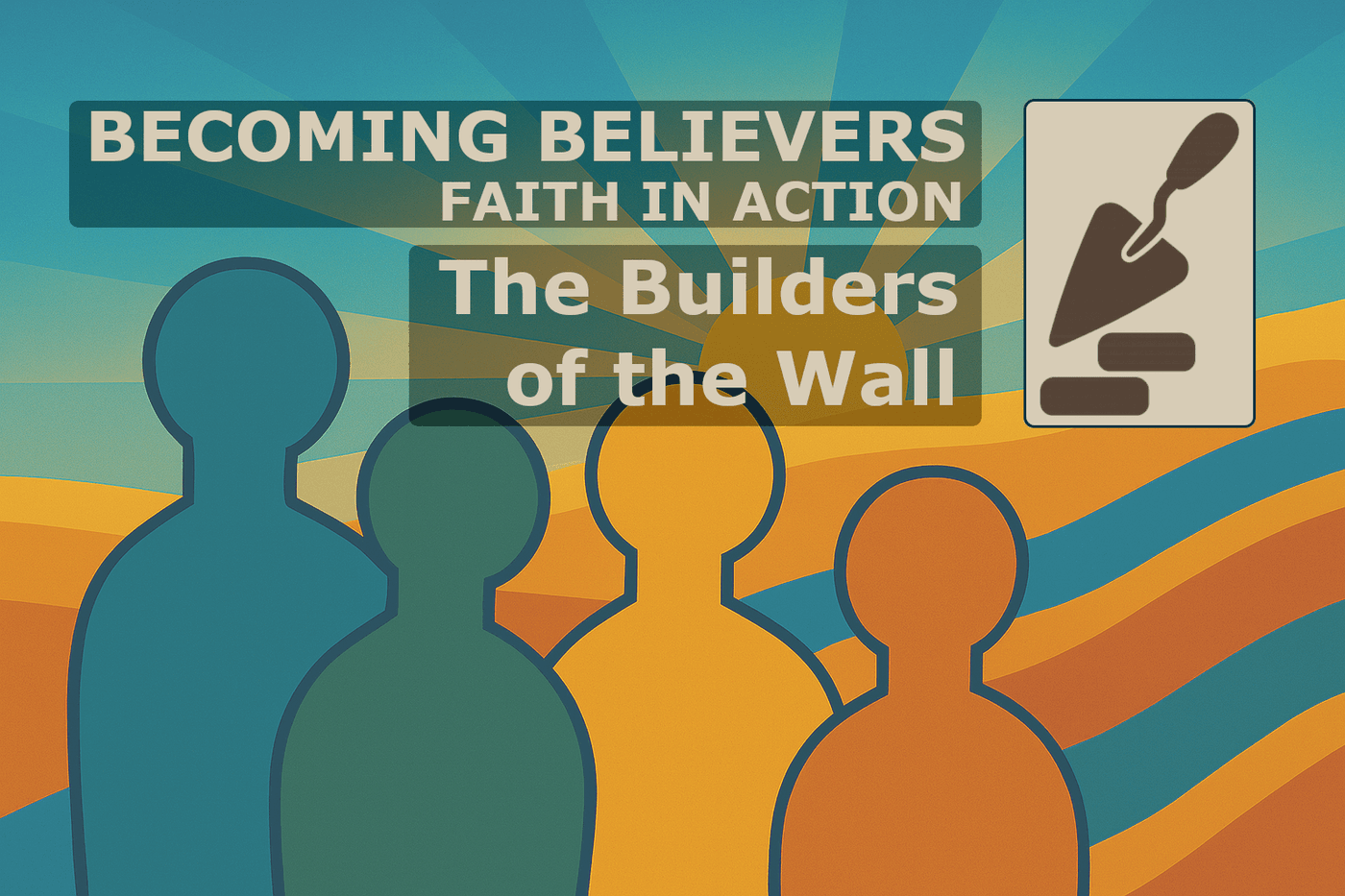
This is the story of a people whose renewed faith stirs them to rise and act.
“Let Us Rise and Build”
Nehemiah gets the movie tagline, “Let us rise and build.”
Imagine that line from Charlton Heston, or Morgan Freeman… Star of the show, obviously.
But it’s only the leading line. It’s meaningless if it does not result in action.
The records that were kept by the Babylonian and Persian courts stand out as some of the most meticulous ancient records we have, so we know much about Nehemiah and those who began to return to Jerusalem.
They are mentioned by name, by region, by profession.
There are men and women, goldsmiths and perfume makers, priests, merchants. Enough diversity to live as a community.
These were all people who had been born and raised in Babylon. Israel had been exiled for 70 years!
Their very first act was to rebuild the altar on Zion.
Before faith can be called into action, it must be activated by the one true God.
True, many great cultures have accomplished many great architectural feets, none of which had anything to do with faith in the God of the Bible.
But this was the City of David, and this was the land in which the Messiah would come.
Rebuilding the city was a holy work. It began with worship.
Another of the ancient poems, this one attributed to Solomon, reminded the people:
When the righteous prosper, the city rejoices.
“Side by Side”
Nehemiah 3 reads like a liturgy of cooperation.
Everyone who responded in faith is mentioned.
Some are mentioned who were not called to action by faith. There will always be those.
But Nehemiah 3 is a great example of how what seems to be a boring list of names, clans, and tasks - it literally reads like a managerial work-report - can be a beautiful hymn of faith.
If you read the list through, a common refrain is sung.
“...and next to him…”
“...and next to him…”
One, next to another, next to another.
This was a community of faith, responding to a city in ruins, for the good of even those who weren’t part of their team.
They were not each busy rebuilding his own home. They combined their efforts first to rebuild the city walls, so that all would benefit.
“All” came before “me”. That’s faith in action.
And remember, it was not because they were attempting to make a name for themselves in history, though ironically we still know them… by name… in Nehemiah 3.
They were renewing the city because Yahweh had renewed them.
“Sanballat’s Mockery”
Faith in action draws resistance.
Maybe we should talk about a movie script, because in walks the villain: Sanballat.
Mockery, threats, political pressure, psychological warfare. All of it in Nehemiah 4.
His strategy half worked.
When opposition arises in the face of active faith, it’s easy to misunderstand.
Some may think that opposition is a sign from God to stop trying.
Others may think that opposition is a sign from within, that my security is more important than anything else.
And others still may see opposition as proof that the entire idea was a bad one to begin with.
Which is why God wasn’t done with Nehemiah yet.
God’s people do need consistent shepherding from the men He calls to lead them. This will not change until He comes again in power.
Nehemiah, a man of prayer, handles Sanballat’s barrage of threats with wisdom and courage from God.
Most importantly, he never proclaimed, “Follow me!”, he taught the people just one refrain:
“Our God will fight for us”.
“The Wall Was Joined”
It’s funny how sometimes the ancient text can be so precise.
After many intriguing episodes of espionage, political trickery, violent skirmishes, and downright betrayal, the wall was joined.
Joined.
Not “finished”, mind you, but “joined”.
And in that one little verse, the wall became a symbol for the people.
No one man could claim the glory.
No one family or clan or any other microcategory of the people could claim the glory.
This was God’s work, and all his people were involved.
What prevented jealousy and politics and violence from derailing the building of the wall?
Because they all “perceived that the work had been done with the help of our God” (6:16).
In that sense, there is no place for religious false humility.
It was a job well done, and everyone could see it, but when God gets the Glory, our boasting in Him is well-placed.
“52 Days”
It’s too bad we didn’t have drone technology in 6th century BC.
The Israelites who rebuilt that wall finished the project in 52 days.
Maybe they should quit their day jobs and start a not-for-profit construction firm!
Can you imagine a time-lapse movie, 52 days condensed to 5 minutes, a community project like no other!
It would go viral!
Alas, no drones. But it did go viral.
It wasn’t just the Israelites who built the wall who “perceived that the work had been done with the help of our God” (6:16)
It was the surrounding nations as well!
Never underestimate the power of the ongoing testimony of faith called to action.
Word made it all the way back to Cyrus, the Persian Overlord, and even that pagan king was pleased.
“The Church Builds”
The takeaway is clear.
God still calls His community of faith to rise and build.
Maybe walls, or maybe something else. But always for the good of our neighbors.
The church certainly meets for worship around the altar. May that never cease.
But then the church finds places to share mercy, generosity, and protection.
The church, by her worship of the one true God of the Bible, is always called to action.
…and next to him…
…and next to her…
…and next to him…
A church.